SodaSlim Official Website › Blog › Caffeine With No Milligrams
Caffeine Anhydrous With No Milligrams On The Label
Caffeine is the best-evidenced ingredient on this shelf and the only one whose effect you can feel within the hour. It is also the first name on the SodaSlim front panel, and the artwork supplied with this product prints no figure for it anywhere.
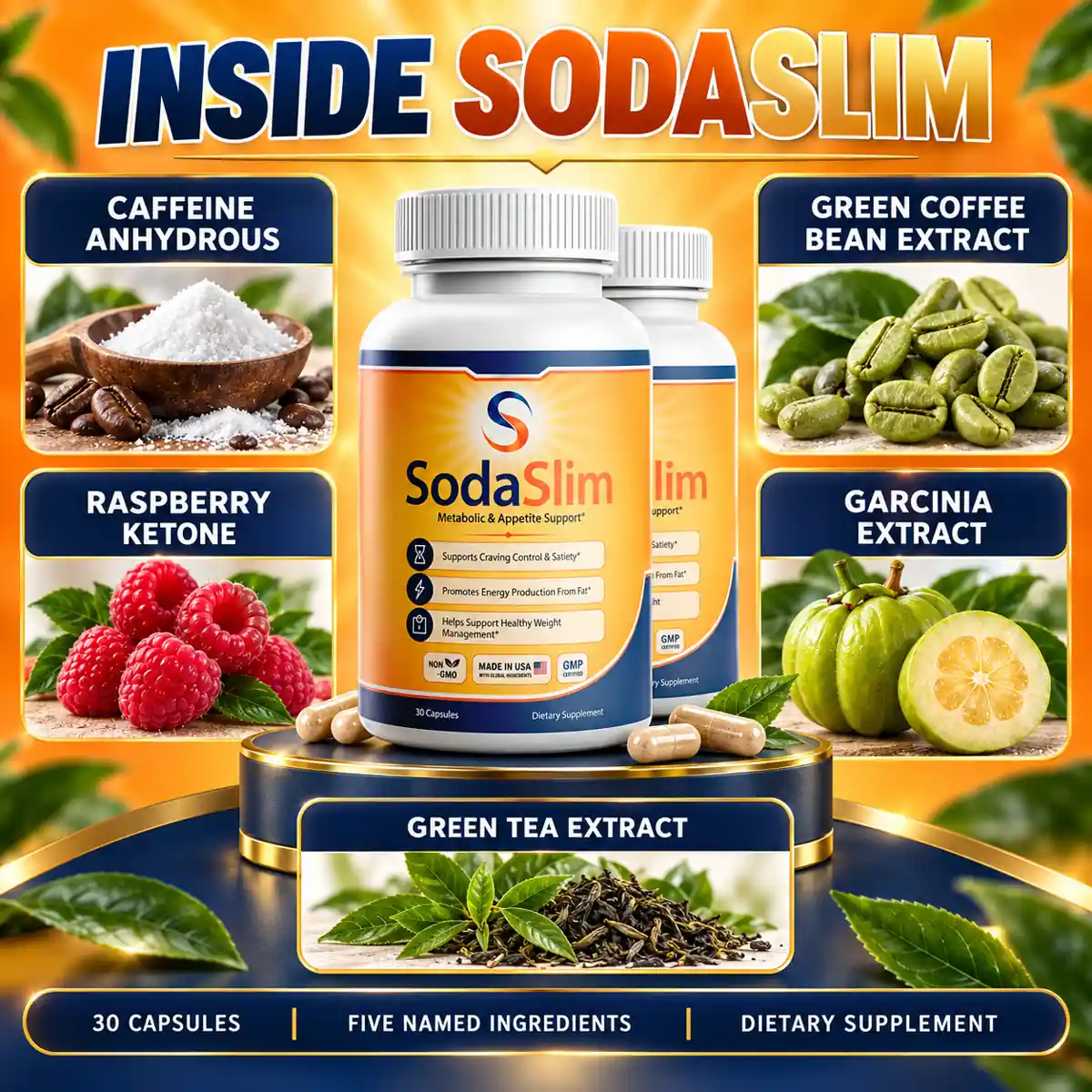
- Caffeine anhydrous is dried, powdered caffeine: the same molecule as in coffee, weighed into a capsule.
- Its effects are dose-dependent and were measured directly at 100, 200 and 400 mg.
- The 2017 safety review works to 400 mg a day for healthy adults.
- This label prints no figure, so the capsule has to be treated as a caffeinated drink of unknown strength.
- The workable rule is subtraction: drop a cup on the mornings you take it, rather than keeping the day as it was.
What caffeine anhydrous is
Anhydrous means without water. Caffeine anhydrous is caffeine that has been dried to a powder so it can be weighed accurately and pressed into a capsule or a tablet. It is chemically identical to the caffeine in a cup of coffee.
The difference is not the molecule, it is the packaging. A coffee announces roughly how strong it is: the size of the cup, the kind of roast and the way it was made all give a drinker a rough sense of the dose, and a person who has had three cups knows they have had three cups. A capsule gives none of that unless the label prints a number.
That is why caffeine anhydrous is such a common ingredient in this category. It is cheap, it works, its effects are well documented, and it makes a product feel like it is doing something within the first hour. It is also the ingredient most likely to be the reason somebody stops taking a capsule.
What the evidence actually shows
Unusually for this shelf, the caffeine evidence is clean and it is quantitative.
| Caffeine dose | What was measured | Where it comes from |
|---|---|---|
| 100 mg | A measurable rise in energy expenditure | The 1990 dose-response study, lowest arm |
| 200 mg | A larger rise, on the same curve | The same study, middle arm |
| 400 mg | The largest rise measured, and the daily ceiling for healthy adults | The same study's top arm, and the 2017 safety review's figure |
| Above 400 mg/day | Diastolic pressure rises in the non-linear analysis | A 2023 dose-response meta-analysis of blood pressure |
| Any dose, taken late | Total sleep time falls and sleep onset is delayed | A 2023 meta-analysis of caffeine and subsequent sleep |
Five findings, all from randomised human work, all expressed in milligrams. None of them can be applied to a capsule whose amount is unknown.
The 1990 dose-response study is the foundation: healthy volunteers with moderate habitual caffeine intake were given placebo and 100, 200 and 400 mg of oral caffeine, and energy expenditure rose dose-dependently. That is the finding the whole thermogenic category rests on.
The 2017 systematic safety review sets the other end of the scale, working to 400 mg a day as the figure for healthy adults, with lower figures for pregnancy and for adolescents. A 2023 dose-response meta-analysis of blood pressure found caffeine supplementation raised systolic and diastolic pressure on average, with the non-linear analysis identifying doses above 400 mg a day as the point where diastolic pressure moved.
A broader review of caffeine and human health covers the ordinary range of effects at ordinary amounts: alertness, diuresis, jitteriness in sensitive people, and a withdrawal headache on a missed day.
Why the amount is the whole question
Every one of those findings is expressed in milligrams, and every one of them becomes unusable the moment the milligrams are unknown.
Consider what a reader is actually trying to do. They want to know whether the capsule will keep them awake, whether it will sit badly on top of their usual coffee, whether it is likely to nudge a blood pressure reading, and whether the effect will be big enough to matter. All four questions have answers in the literature and all four answers are functions of the dose.
Without a figure, none of them can be asked. What remains is a capsule you can only assess by taking it, which is a reasonable thing to do once on a morning you can pay attention, and a poor way to run a routine for six months.
The caffeine budget, in ordinary drinks
The practical version of the problem is arithmetic that cannot be completed.
| Everyday source | Typical caffeine | What that leaves of a 400 mg day |
|---|---|---|
| A mug of filter coffee | Around 95 mg | About 305 mg |
| A double espresso | Around 125 mg | About 275 mg |
| A large shop-bought coffee | 150–200 mg | 200–250 mg |
| A mug of black tea | Around 45 mg | About 355 mg |
| A can of energy drink | Around 80 mg | About 320 mg |
| One SodaSlim capsule | Not printed on the label | Unknown |
Typical figures for common drinks, set against the 400 mg a day the 2017 safety review works to for healthy adults. The last row is the problem this article is about.
Fill in any ordinary morning and the difficulty is obvious. A mug of filter coffee and a couple of teas across the afternoon is somewhere around 185 mg, well inside the figure the safety review works to. Add a capsule of unknown strength and the day's total is unknowable rather than merely higher.
It matters more for some readers than others. Somebody who drinks nothing caffeinated has the whole budget to play with. Somebody already on four coffees has very little, and is also, on the evidence, least likely to get much from the thermogenic side because tolerance blunts it.
SodaSlim is one capsule, taken in the morning
Which is the routine the direction sets and the reason it does. 60 days from the date of purchase, opened bottles included, on every pack.
Two bottles $158 · six bottles $294 · 60-day money-back guarantee
Choose A SodaSlim PackThirty capsules, thirty mornings · lot SOD-26/SA-1714 · ships from the U.S.
The subtraction rule
There is one rule that works under uncertainty, and it is to subtract rather than to add.
- Count what your day normally contains. The table above is enough precision for this; nobody needs to be exact.
- On the mornings you take the capsule, drop one cup. Not add the capsule on top of an unchanged day.
- Keep the first three mornings somewhere you can notice how you feel. Not a meeting, not a long drive.
- Treat jitteriness, a racing pulse or a bad night as information. They are reasons to stop rather than a phase to endure.
- Never take a second capsule because the first felt like nothing. That is doubling an unknown, and it is the one thing to avoid.
That routine costs nothing, it does not require a figure, and it converts an unknown into something manageable. It is also the honest limit of what a retail desk can offer in place of a number the manufacturer has not printed.
Sleep, and why the direction says morning
The direction printed for this product is one capsule daily, taken in the morning. The seller frames that in terms of appetite and energy during the day, which is fair. The stronger reason is sleep.
A 2023 systematic review and meta-analysis of caffeine and subsequent sleep found that caffeine reduces total sleep time and lengthens how long it takes to fall asleep, with both effects depending on the dose and on how late it is taken. A capsule of unspecified strength in the evening is the one reliable way to turn this product into a problem.
And short sleep raises appetite, which works directly against what the bottle is sold to support. A product taken for craving control that costs an hour of sleep is working against itself, so the morning instruction is doing more than it looks.
That is a fit problem rather than a teething problem, and it does not improve with persistence. The sixty-day window exists for exactly that situation and opened bottles are included.
Why this desk will not estimate a figure
It would be easy to. Products in this category typically carry somewhere between 50 and 200 mg of caffeine in a once-daily capsule, and a sentence saying so would read as helpful.
It would also be a guess dressed as information. A reader would take the middle of that range, plan their day around it, and be planning around a number this desk made up. If the real figure were at either end, the plan would be wrong in a direction that matters.
There is a second reason, and the analytical work behind the Dietary Supplement Ingredient Database is the illustration: even a printed figure is a declared amount rather than a measured one, and analytical surveys routinely find declared and measured amounts differ. A label that prints nothing is not one step from certainty; it is two.
So the refusal is recorded rather than quietly worked around. It sits with three others on the disclaimer.
What the label would have to print
One row in a Supplement Facts panel would close the whole of this article.
- A serving size, and the number of servings in the bottle.
- Caffeine anhydrous, in milligrams per serving. The single most useful number this product could publish.
- A milligram figure for each of the other four botanicals, with an extract ratio or a marker standardisation.
- An other-ingredients line, which would also settle what the capsule shell is made of.
- An allergen statement, and the lot and best-before printed on the base.
None of that is unusual. It is the ordinary content of a supplement label in the United States and a great many products on the same shelf print all of it.
If the bottle you receive carries a back label with those figures on it, that label is the authority and this article is out of date. Send a photograph to this desk and the ingredients page will be rewritten the same week.
SodaSlim is a dietary supplement, not a treatment. Nothing in this article diagnoses anything or tells you to start, stop or change a medicine. There is caffeine in the capsule and no figure beside it on the bottle, so anyone already on a prescription should put the label in front of whoever wrote it before the first dose.
References
- Astrup A, Toubro S, Cannon S, et al. Caffeine: a double-blind, placebo-controlled study of its thermogenic, metabolic, and cardiovascular effects in healthy volunteers. Am J Clin Nutr. 1990;51(5):759-67. PMID 2333832. https://pubmed.ncbi.nlm.nih.gov/2333832/
- Wikoff D, Welsh BT, Henderson R, et al. Systematic review of the potential adverse effects of caffeine consumption in healthy adults, pregnant women, adolescents, and children. Food Chem Toxicol. 2017;109(Pt 1):585-648. PMID 28438661. https://pubmed.ncbi.nlm.nih.gov/28438661/
- Abbas-Hashemi SA, Hosseininasab D, Rastgoo S, et al. The effects of caffeine supplementation on blood pressure in adults: a systematic review and dose-response meta-analysis. Clin Nutr ESPEN. 2023;58:165-177. PMID 38057002. https://pubmed.ncbi.nlm.nih.gov/38057002/
- Gardiner C, Weakley J, Burke LM, et al. The effect of caffeine on subsequent sleep: a systematic review and meta-analysis. Sleep Med Rev. 2023;69:101764. PMID 36870101. https://pubmed.ncbi.nlm.nih.gov/36870101/
- Nawrot P, Jordan S, Eastwood J, et al. Effects of caffeine on human health. Food Addit Contam. 2003;20(1):1-30. PMID 12519715. https://pubmed.ncbi.nlm.nih.gov/12519715/
- Andrews KW, Gusev PA, Savarala S, et al. Dietary Supplement Ingredient Database (DSID) and the application of analytically based estimates of ingredient amount to intake calculations. J Nutr. 2018;148(suppl_2):1413S-1421S. PMID 31505677. https://pubmed.ncbi.nlm.nih.gov/31505677/
Read the SodaSlim bottle you receive
If it prints a caffeine figure this website does not, the bottle is right and this desk wants to know. 60 days from the date of purchase, either way.
Two bottles $158 · six bottles $294 · 60-day money-back guarantee
Choose A SodaSlim PackThirty capsules, thirty mornings · lot SOD-26/SA-1714 · ships from the U.S.