SodaSlim Official Website › How It Works
How It WorksHow SodaSlim Works: Thermogenesis, Satiety And What Is Actually Proposed
SodaSlim proposes two routes at once. Caffeine anhydrous and green tea extract are thermogenic, meaning they raise the energy the body spends at rest; garcinia and green coffee are appetite-side, one through an enzyme in fat assembly and one through the speed of sugar absorption. Raspberry ketone has a mechanism described only in mice and in cells.
Four mechanisms with human evidence behind them, one without, and the honest distance between a mechanism and a result.
The two halves of the SodaSlim proposition
Energy out: thermogenesis
Caffeine raises energy expenditure and the effect scales with the dose. The 1990 crossover study measured it directly at 100, 200 and 400 mg. Green tea extract adds to it rather than duplicating it: in the respiratory-chamber trial, 270 mg of EGCG taken with 150 mg of caffeine over a day raised twenty-four-hour energy expenditure by four per cent, while the same caffeine alone did not.
Energy in: appetite and absorption
Garcinia's hydroxycitric acid inhibits ATP citrate lyase, the enzyme that takes citrate towards fat synthesis, with fullness proposed as the downstream effect. Green coffee's chlorogenic acid is proposed to slow how fast sugars leave the gut. And caffeine has its own appetite arm: the 2017 review collects the trials on how long people go before eating again.
Set out like that, the formula reads as a deliberate pairing rather than a list. Two ingredients on the output side, two on the intake side, and one — raspberry ketone — that was included for a mechanism nobody has yet shown in a person.
What the pairing cannot do is tell you the size of anything. A mechanism is a description of a route, not a measurement of how much travels along it, and the gap between the two is where most of this category's marketing lives.
What thermogenesis means, and what it does not, for SodaSlim
Thermogenesis is heat production, and in this context it means the energy a body spends doing nothing in particular. Raising it is the oldest idea in this category and it is genuinely measurable: a metabolic chamber can detect a four per cent shift over twenty-four hours, which is what Dulloo and colleagues reported.
Four per cent of a day's resting expenditure is a real number and a small one. On a 2,000-calorie resting budget it is in the region of eighty calories, which is a biscuit. It is not nothing, and it is not the difference between one outcome and another on its own. Anyone selling thermogenesis as a mechanism that does the work unaided is overselling a finding that its own authors framed carefully.
The second thing worth knowing is that tolerance matters. The 2009 meta-analysis found the effect of catechin and caffeine mixtures smaller in habitual caffeine consumers than in people who rarely drink it. Somebody on three coffees a day is the least likely person in the room to notice a capsule of unknown strength.
Twenty-four-hour energy expenditure rose four per cent on an extract supplying 270 mg of EGCG and 150 mg of caffeine a day. Caffeine alone at the same amount produced no change in energy expenditure or respiratory quotient. That is the finding the green tea half of this formula stands on, and it was made in ten men in a chamber, not in a population over a year.
What the appetite side of SodaSlim is proposed to do
The appetite argument has three strands and they are of very different strengths.
Hydroxycitric acid is the most cited and the least supported. Its enzyme mechanism is textbook chemistry, but the largest randomised trial gave 1,500 mg a day for twelve weeks to 135 overweight adults alongside a controlled diet and found no significant difference in weight or fat mass against placebo. The meta-analysis that followed found a small pooled difference drawn from trials it described as mostly poor in quality. A mechanism that works in a test tube and fails in a twelve-week trial is a mechanism that has been tested and answered.
Chlorogenic acid has the better recent record of the two. The eight-week metabolic-syndrome trial at 400 mg twice daily reported a lower appetite score as well as lower fasting glucose and systolic pressure, and the 2023 meta-analysis at 500 mg a day found a pooled 1.3 kg difference across three trials. Small, consistent and at stated amounts.
Caffeine's own appetite effect is the third strand, and the review of it concludes that the suppression is real in the hours after a dose and does not reliably carry through to lower intake across a whole day.
Where SodaSlim has a mechanism but no human measurement
Raspberry ketone is the one ingredient on this label with no human trial of its own. That sentence is not a rhetorical flourish; it is the state of the literature.
The 2005 mouse work fed diets containing half to two per cent raspberry ketone for ten weeks and reported less weight gained on a high-fat diet and less fat in the liver, with a plausible route: increased noradrenaline-induced lipolysis in fat cells. Cell work on 3T3-L1 adipocytes and a second study on the same line describe that route in more detail.
The only trial in people that contained it, an eight-week study, tested raspberry ketone together with caffeine, capsaicin, garlic, ginger and Citrus aurantium against placebo, alongside a calorie-restricted diet and exercise. The supplemented group did better. Which of six ingredients was responsible is a question that design cannot answer, and its authors did not claim otherwise.
So the right way to read raspberry ketone on this bottle is as a bet rather than as a finding. It may do something. Nobody has measured what, in a person, at any amount.
Why SodaSlim cannot be compared with any of these trials
| Trial | What it gave | For how long | What it found |
|---|---|---|---|
| Astrup 1990, caffeine | 100, 200 and 400 mg, single doses | Acute | Energy expenditure rose with the dose |
| Dulloo 1999, green tea extract | 270 mg EGCG + 150 mg caffeine a day | Three treatment days in a chamber | 24-hour energy expenditure +4%; caffeine alone did nothing |
| Heymsfield 1998, garcinia | 1,500 mg HCA a day | 12 weeks | No significant difference against placebo |
| Roshan 2018, green coffee | 400 mg extract twice a day | 8 weeks | Lower systolic pressure, fasting glucose and appetite score |
| Chen 2016, green tea extract | 856.8 mg EGCG a day | 12 weeks | About 1.1 kg, with lower ghrelin and higher adiponectin |
| Morimoto 2005, raspberry ketone | 0.5-2% of the diet, in mice | 10 weeks | Less weight gained on a high-fat diet |
Every figure read from the paper's own methods section during the citation pass for this site.
Set beside that table, SodaSlim is a capsule with five names and no numbers. The comparison a reader wants — is the green tea in here at 90 mg of EGCG or at 500 — is one the label makes impossible.
What the table is still good for is calibration. It shows the size of the effects this chemistry produces even at generous amounts under supervision: single-digit percentages of energy expenditure, one to one and a half kilograms over three months, and in one case nothing at all. Anyone approaching a capsule with those expectations is unlikely to be disappointed by week six, and that matters more than the milligram question.
What actually moves the needle alongside SodaSlim
- Sleep. Caffeine late in the day shortens it, and short sleep raises appetite. The morning instruction on this bottle is doing more work than it looks.
- Protein and fibre at breakfast, which change how long a morning lasts more reliably than any capsule in this category.
- Walking. Unglamorous, and the one intervention that appears in nearly every successful arm of the trials above, because every one of them ran alongside diet or exercise advice.
- Alcohol, which is the largest uncounted energy source in most weeks.
- Keeping the routine long enough to judge it. Every trial above ran eight to twelve weeks; the commonest complaint about this product concerns week one.
Every trial cited on this page was run on top of a diet, an exercise programme, or both. Not one of them tested a supplement against nothing at all, because that is not how the question is asked. Reading the results as though the capsule acted alone is the single commonest error in this category.
Sources behind this SodaSlim mechanism page
- Astrup A, Toubro S, Cannon S, et al. Caffeine: a double-blind, placebo-controlled study of its thermogenic, metabolic, and cardiovascular effects in healthy volunteers. Am J Clin Nutr. 1990;51(5):759-67. PMID 2333832. https://pubmed.ncbi.nlm.nih.gov/2333832/
- Schubert MM, Irwin C, Seay RF, et al. Caffeine, coffee, and appetite control: a review. Int J Food Sci Nutr. 2017;68(8):901-912. PMID 28446037. https://pubmed.ncbi.nlm.nih.gov/28446037/
- Dulloo AG, Duret C, Rohrer D, et al. Efficacy of a green tea extract rich in catechin polyphenols and caffeine in increasing 24-h energy expenditure and fat oxidation in humans. Am J Clin Nutr. 1999;70(6):1040-5. PMID 10584049. https://pubmed.ncbi.nlm.nih.gov/10584049/
- Hursel R, Viechtbauer W, Westerterp-Plantenga MS. The effects of green tea on weight loss and weight maintenance: a meta-analysis. Int J Obes (Lond). 2009;33(9):956-61. PMID 19597519. https://pubmed.ncbi.nlm.nih.gov/19597519/
- Chen IJ, Liu CY, Chiu JP, Hsu CH. Therapeutic effect of high-dose green tea extract on weight reduction: a randomized, double-blind, placebo-controlled clinical trial. Clin Nutr. 2016;35(3):592-9. PMID 26093535. https://pubmed.ncbi.nlm.nih.gov/26093535/
- Heymsfield SB, Allison DB, Vasselli JR, et al. Garcinia cambogia (hydroxycitric acid) as a potential antiobesity agent: a randomized controlled trial. JAMA. 1998;280(18):1596-600. PMID 9820262. https://pubmed.ncbi.nlm.nih.gov/9820262/
- Onakpoya I, Hung SK, Perry R, Wider B, Ernst E. The use of Garcinia extract (hydroxycitric acid) as a weight loss supplement: a systematic review and meta-analysis of randomised clinical trials. J Obes. 2011;2011:509038. PMID 21197150. https://pubmed.ncbi.nlm.nih.gov/21197150/
- Roshan H, Nikpayam O, Sedaghat M, Sohrab G. Effects of green coffee extract supplementation on anthropometric indices, glycaemic control, blood pressure, lipid profile, insulin resistance and appetite in patients with the metabolic syndrome: a randomised clinical trial. Br J Nutr. 2018;119(3):250-258. PMID 29307310. https://pubmed.ncbi.nlm.nih.gov/29307310/
- Kanchanasurakit S, Saokaew S, Phisalprapa P, Duangjai A. Chlorogenic acid in green bean coffee on body weight: a systematic review and meta-analysis of randomized controlled trials. Syst Rev. 2023;12(1):163. PMID 37710316. https://pubmed.ncbi.nlm.nih.gov/37710316/
- Morimoto C, Satoh Y, Hara M, et al. Anti-obese action of raspberry ketone. Life Sci. 2005;77(2):194-204. PMID 15862604. https://pubmed.ncbi.nlm.nih.gov/15862604/
- Park KS. Raspberry ketone increases both lipolysis and fatty acid oxidation in 3T3-L1 adipocytes. Planta Med. 2010;76(15):1654-8. PMID 20425690. https://pubmed.ncbi.nlm.nih.gov/20425690/
- Park KS. Raspberry ketone, a naturally occurring phenolic compound, inhibits adipogenic and lipogenic gene expression in 3T3-L1 adipocytes. Pharm Biol. 2015;53(6):870-5. PMID 25429790. https://pubmed.ncbi.nlm.nih.gov/25429790/
- Lopez HL, Ziegenfuss TN, Hofheins JE, et al. Eight weeks of supplementation with a multi-ingredient weight loss product enhances body composition, reduces hip and waist girth, and increases energy levels in overweight men and women. J Int Soc Sports Nutr. 2013;10(1):22. PMID 23601452. https://pubmed.ncbi.nlm.nih.gov/23601452/
SodaSlim is a routine, not a shortcut
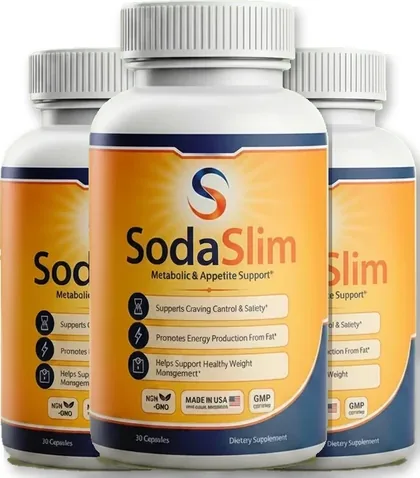
One capsule each morning for the length of a bottle is the way this formula is meant to be judged. 60 days from purchase to decide, with opened bottles included.
Two bottles $158 · six bottles $294 · 60-day money-back guarantee
Choose A SodaSlim PackThirty capsules, thirty mornings · lot SOD-26/SA-1714 · ships from the U.S.