SodaSlim Official Website › Blog › Garcinia And The Liver
Garcinia Cambogia And The Liver: Reading The Case Reports Carefully
Garcinia has the most cited mechanism on this shelf, the clearest negative trial, and a safety literature made of case reports. All three are worth understanding, and the third is the one most often either ignored or exaggerated.
- Hydroxycitric acid inhibits ATP citrate lyase, which is textbook chemistry.
- The largest trial gave 1,500 mg a day for twelve weeks to 135 adults and found no significant difference against placebo.
- Published case reports describe acute liver failure, serotonin toxicity and mania.
- A case report establishes that something can happen, not how often.
- Anyone taking an SSRI or SNRI should raise this bottle with their prescriber.
What garcinia extract is
An extract of the rind of Garcinia cambogia, a small fruit grown in South and Southeast Asia, where the rind has a long culinary history. Supplement extracts are standardised for hydroxycitric acid, usually to 50 or 60 per cent, and the HCA content is the whole reason the ingredient is on a label.
It is one of the most widely used weight-related botanicals in the world and it has been studied for decades, which makes it unusual on this shelf: the question of whether it works has actually been asked properly, and answered.
The mechanism, and why it is so often cited
Hydroxycitric acid competitively inhibits ATP citrate lyase, the enzyme that converts citrate into acetyl-CoA outside the mitochondria. Acetyl-CoA is the starting point for assembling fatty acids, so inhibiting the enzyme should, in principle, slow the conversion of surplus carbohydrate into fat. A rise in satiety is proposed as a downstream consequence.
This is a genuinely elegant mechanism and it is easy to explain, which is exactly why it appears in so much marketing. It is also a good illustration of why a mechanism is not a result: a step can be inhibited in a laboratory and the inhibition can turn out to make no measurable difference to a person over twelve weeks.
The trial that found nothing
The largest and best-known trial was published in JAMA in 1998.
| What the JAMA trial did | What it found | |
|---|---|---|
| Design | 12-week randomised, double-blind, placebo-controlled | — |
| Participants | 135 overweight men and women, mean BMI about 32 | — |
| Intervention | 1,500 mg of hydroxycitric acid a day, or placebo | — |
| Both arms | A high-fibre, reduced-energy diet | — |
| Weight change | 3.2 kg on garcinia, 4.1 kg on placebo | Not statistically significant between groups |
| Fat mass | Measured at weeks 0 and 12 | No significant difference between groups |
Read from the trial's own methods and results. Both groups lost weight; the difference between them did not reach significance.
One hundred and thirty-five overweight adults were randomised to 1,500 mg of hydroxycitric acid a day or to placebo for twelve weeks, with both groups prescribed the same high-fibre, reduced-energy diet. Both groups lost a significant amount of weight. The difference between them — 3.2 kg against 4.1 kg, numerically favouring placebo — did not reach statistical significance, and there was no significant difference in the percentage of body fat lost.
The authors' conclusion was that garcinia cambogia failed to produce significant weight loss and fat mass loss beyond that observed with placebo. It is a clear result from a well-designed trial at a generous dose, and it is twenty-eight years old.
What the meta-analysis added
A 2011 systematic review and meta-analysis pooled the randomised evidence on garcinia extract as a weight loss supplement. It found a small difference in favour of the extract whose magnitude was uncertain, and described the trials it drew on as generally of poor methodological quality.
A separate evaluation of safety and efficacy in humans reached a similar position on both halves of the question.
That is where the evidence sits. A famous mechanism, one large negative trial, and a pooled analysis whose own authors describe its inputs as weak. Nothing about that makes garcinia unsafe or useless; it makes it an ingredient whose reputation runs well ahead of its results.
It is worth being precise about what a negative trial does and does not settle. The JAMA study tested one preparation, at one amount, over twelve weeks, in adults whose diets were controlled alongside it. It does not prove the ingredient can never do anything in any circumstance. What it does is remove the easy version of the argument: the mechanism alone is no longer a sufficient reason to expect a result, because somebody has looked properly and not found one. An ingredient in that position needs new evidence rather than a better explanation, and in the twenty-eight years since, none of comparable size has arrived.
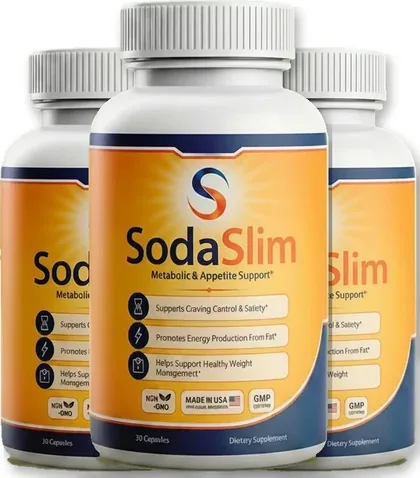
Garcinia is one of five names on SodaSlim
One capsule each morning, thirty to a bottle, and 60 days from the date of purchase with opened bottles included.
Two bottles $158 · six bottles $294 · 60-day money-back guarantee
Choose A SodaSlim PackThirty capsules, thirty mornings · lot SOD-26/SA-1714 · ships from the U.S.
The case reports, read carefully
| Report | What was described | What it establishes | What it does not |
|---|---|---|---|
| Lunsford 2016 | Acute hepatic failure requiring liver transplantation, attributed to a garcinia-containing supplement | That severe liver injury has been attributed to this ingredient | How often it happens, or at what dose |
| Lopez 2014 | Serotonin toxicity in a patient taking an antidepressant alongside an over-the-counter garcinia supplement | A specific interaction worth raising with a prescriber | That the interaction is common |
| Nguyen 2019 | Mania with psychosis, possibly induced by garcinia cambogia | That psychiatric effects have been reported | Causation, which a single case cannot establish |
Three published case reports. A case report establishes that something can happen; it cannot give an incidence rate.
The transplantation case is the most serious of the three: acute hepatic failure attributed to a garcinia-containing supplement, requiring a liver transplant. The serotonin toxicity case involved an over-the-counter garcinia product in a patient taking an antidepressant. The third describes mania with psychosis, possibly induced by garcinia cambogia.
These are three published reports about an ingredient taken by very large numbers of people. That ratio matters and it cuts both ways: it means severe events are clearly not common, and it means they have happened.
How to read a case report
A case report is a doctor writing down something unusual they saw. It is the weakest form of published evidence about cause and the strongest available signal that something can happen at all.
- It cannot give an incidence rate. There is no denominator: nobody knows how many people took the same product without incident.
- It cannot establish causation. It can establish plausibility, timing and, occasionally, recurrence on rechallenge.
- It often involves a product rather than an ingredient. Supplements contain several things and are sometimes adulterated with things not on the label.
- It is subject to reporting bias in both directions. Dramatic cases get written up; ordinary ones do not, and most adverse events are never reported at all.
- It is still the reason a specific interaction gets onto a checklist. The serotonin case is why an SSRI belongs in a conversation with a prescriber.
The right response to three case reports is neither to ignore them nor to treat them as a risk estimate. It is to notice which specific circumstances they describe and to act on those.
Who should raise it with a prescriber
- Anyone taking an SSRI, SNRI or another serotonergic medicine. This is the specific, actionable one.
- Anyone with liver trouble, past or present. Two of the five ingredients on this label carry liver findings in the literature.
- Anyone taking a medicine that is itself hard on the liver. The question is the total load, not any one product.
- Anyone with a psychiatric history involving mania. One report is thin, and it is not nothing.
- Anyone being treated for anything at all, in practice. Telling a prescriber what you take by name costs a sentence.
What to watch for, if you do take it, is short and specific: yellowing of the eyes or skin, dark urine, pain under the right ribs, or unusual tiredness with nausea. Those are the picture of a liver problem and they are reasons to stop and be seen the same day rather than to wait.
The full list, covering all five ingredients, is on side effects.
What this means for this label
SodaSlim names garcinia extract fourth and prints no amount for it, and no hydroxycitric acid percentage.
That cuts in an unusual direction here. For most ingredients a missing amount means a reader cannot tell whether there is enough to do anything. For garcinia, the trial evidence suggests that even a generous amount — 1,500 mg of HCA a day for twelve weeks — produced nothing measurable, so the missing figure is less consequential for efficacy than it is elsewhere on the label.
For safety it cuts the other way. The case reports do not come with a threshold dose, so a reader who wanted to reason about exposure has nothing to reason with. That is the argument for raising the bottle with a prescriber by name rather than by category.
The same treatment of the other four names is on the ingredients page, and the interactions table is at interactions.
SodaSlim is a dietary supplement, not a treatment. Nothing in this article diagnoses anything or tells you to start, stop or change a medicine. There is caffeine in the capsule and no figure beside it on the bottle, so anyone already on a prescription should put the label in front of whoever wrote it before the first dose.
References
- Heymsfield SB, Allison DB, Vasselli JR, et al. Garcinia cambogia (hydroxycitric acid) as a potential antiobesity agent: a randomized controlled trial. JAMA. 1998;280(18):1596-600. PMID 9820262. https://pubmed.ncbi.nlm.nih.gov/9820262/
- Onakpoya I, Hung SK, Perry R, Wider B, Ernst E. The use of Garcinia extract (hydroxycitric acid) as a weight loss supplement: a systematic review and meta-analysis of randomised clinical trials. J Obes. 2011;2011:509038. PMID 21197150. https://pubmed.ncbi.nlm.nih.gov/21197150/
- Marquez F, Babio N, Bullo M, Salas-Salvado J. Evaluation of the safety and efficacy of hydroxycitric acid or Garcinia cambogia extracts in humans. Crit Rev Food Sci Nutr. 2012;52(7):585-94. PMID 22530711. https://pubmed.ncbi.nlm.nih.gov/22530711/
- Lunsford KE, Bodzin AS, Reino DC, Wang HL, Busuttil RW. Dangerous dietary supplements: Garcinia cambogia-associated hepatic failure requiring transplantation. World J Gastroenterol. 2016;22(45):10071-10076. PMID 28018115. https://pubmed.ncbi.nlm.nih.gov/28018115/
- Lopez AM, Kornegay J, Hendrickson RG. Serotonin toxicity associated with Garcinia cambogia over-the-counter supplement. J Med Toxicol. 2014;10(4):399-401. PMID 24699886. https://pubmed.ncbi.nlm.nih.gov/24699886/
- Nguyen DC, Timmer TK, Davison BC, McGrane IR. Possible Garcinia cambogia-induced mania with psychosis: a case report. J Pharm Pract. 2019;32(1):99-102. PMID 28982303. https://pubmed.ncbi.nlm.nih.gov/28982303/
Tell a prescriber what is in the SodaSlim bottle
By name, before the first capsule. 60 days from the date of purchase either way, with opened bottles included.
Two bottles $158 · six bottles $294 · 60-day money-back guarantee
Choose A SodaSlim PackThirty capsules, thirty mornings · lot SOD-26/SA-1714 · ships from the U.S.