SodaSlim Official Website › Blog › Green Coffee And A Retraction
Green Coffee Bean Extract, And The Study That Was Retracted
The trial that made green coffee bean extract famous was withdrawn by its own journal in 2014. What survives is smaller, more specific and at doses a reader can actually check — which is the opposite of how the ingredient is usually sold.
- Green coffee bean extract is unroasted coffee, standardised for chlorogenic acid.
- The 2012 study that made it famous was retracted by its journal in 2014 and PubMed flags it accordingly.
- The surviving evidence is modest: about 1.3 kg pooled across three trials at 500 mg a day.
- An eight-week trial at 400 mg twice daily reported a lower appetite score alongside lower fasting glucose.
- This label prints no amount, so none of those figures can be applied to this capsule.
What green coffee bean extract is
Coffee beans that never went near a roaster. Heat is what gives a roasted bean its smell and its taste, and the same heat burns off most of the chlorogenic acids sitting in the raw seed. Pull the extract out first and those acids survive — and chlorogenic acid is the entire reason this ingredient is on a label at all.
A green coffee bean extract therefore has very little to do with drinking coffee. It is usually standardised to a stated percentage of chlorogenic acid — 45 or 50 per cent is common — and it may be decaffeinated or not. That last detail matters on a label that already contains caffeine anhydrous, and this one does not say either way.
The proposed route is that chlorogenic acid slows the absorption of sugars from a meal, with knock-on effects on glucose handling and on how much energy arrives at once.
The 2012 study, and what happened to it
The paper is a twenty-two-week crossover study in sixteen overweight adults, published in 2012. Participants took a high dose of a commercial green coffee extract, a low dose and placebo in separate six-week periods, with washouts between them. The reported result was a fall of about eight kilograms in body weight, nearly three points of body mass index and four percentage points of body fat.
Eight kilograms in sixteen people, with no significant change in diet, is a remarkable claim for a botanical extract. It was reported widely and it is the reason the ingredient appears on labels at all.
In 2014 the journal retracted it. The retraction notice is published in the same journal and PubMed carries the record flagged as a retracted publication, which is how anyone looking it up today finds out.
None of which means chlorogenic acid does nothing. It means the single most impressive number ever attached to this ingredient has been withdrawn from the literature, and a page selling green coffee on the strength of a 2012 headline is selling a result that no longer stands.
The chronology of the evidence
| Year | What happened | What it means now |
|---|---|---|
| 2011 | A systematic review of green coffee extract finds the trials few, small and poor in quality | The honest starting position, and it was published before the famous one |
| 2012 | A crossover study in 16 overweight adults reports about 8 kg lost on 700 and 1,050 mg a day | The result that made the ingredient famous |
| 2014 | The journal retracts that paper | PubMed carries it flagged as a retracted publication |
| 2018 | An eight-week trial at 400 mg twice a day reports a lower appetite score, lower fasting glucose and lower systolic pressure | Small, specific, and at a stated dose |
| 2023 | A meta-analysis of three trials at 500 mg a day finds a pooled difference of about 1.3 kg | The current best estimate, and modest |
A chronology of the published record, taken from the papers themselves. The 2014 retraction notice is in the same journal as the 2012 paper.
The chronology is worth reading in order, because the first row is the one most often left out. A systematic review published in 2011 — before the famous study — already found the trials few, small and of poor methodological quality, and concluded that the evidence was not convincing.
What happened next is a familiar shape in this category. One dramatic result arrived, was amplified far beyond its size, and was then withdrawn; the modest work that came afterwards received a fraction of the attention and is the part that actually holds.
What survives, and at what dose
| Study | Dose of extract | Duration | Outcome |
|---|---|---|---|
| Vinson 2012 (RETRACTED) | 700 mg and 1,050 mg a day | 6 weeks per arm | About 8 kg. Withdrawn by the journal in 2014 |
| Roshan 2018 | 400 mg twice a day, decaffeinated | 8 weeks | Lower SBP, fasting glucose, insulin resistance and appetite score |
| Kanchanasurakit 2023 meta-analysis | At least 500 mg a day, standardised for chlorogenic acid | Pooled across three trials, 103 people | About 1.3 kg |
| SodaSlim | Not printed on the label | One capsule daily | Not measured |
Three published doses and one label that gives none. The last row is why the first three cannot be applied to this capsule.
A 2023 systematic review and meta-analysis pooled three randomised trials in 103 people, all using green bean coffee extract supplying at least 500 mg a day of chlorogenic acid, and found a weighted mean difference of about 1.3 kg in favour of the extract, with no heterogeneity between the studies and no evidence of publication bias. Its own authors describe the sample as limited and the follow-up as short.
An eight-week randomised trial in patients with metabolic syndrome used 400 mg of decaffeinated extract twice a day alongside an energy-balanced diet. Systolic pressure fell further than placebo, fasting blood glucose and insulin resistance improved, waist circumference fell, and the appetite score dropped. Weight reduction was about twice the placebo group's, which the authors described as marginally significant.
So the honest summary is one to one and a half kilograms over two to three months, at 500 to 800 mg a day of a standardised extract, on top of a diet. Small, real, and nothing like eight kilograms.
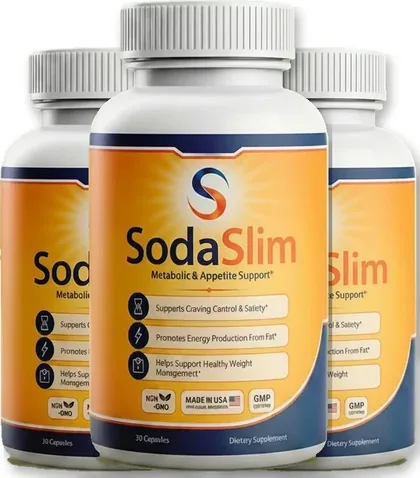
Green coffee is one of five names on the SodaSlim bottle
One capsule each morning, thirty to a bottle, and 60 days from the date of purchase with opened bottles included.
Two bottles $158 · six bottles $294 · 60-day money-back guarantee
Choose A SodaSlim PackThirty capsules, thirty mornings · lot SOD-26/SA-1714 · ships from the U.S.
The mechanism, described carefully
Chlorogenic acid is proposed to inhibit an enzyme involved in releasing glucose into the bloodstream and to slow how quickly sugars are absorbed from the gut. The consequence would be a flatter rise in blood sugar after a meal and less of a surge of energy arriving at once.
That is a mechanism rather than an outcome, and the distinction is the one this whole blog keeps returning to. The glucose findings in the eight-week trial are consistent with it. The weight findings are small and their relationship to the mechanism is inferred rather than demonstrated.
It is also worth noticing what the mechanism implies about timing: an ingredient that works on the absorption of a meal is one you would expect to take with meals, and this capsule is directed once in the morning. That is not a criticism — a once-daily routine is the reason anybody keeps taking it — but it is a reason not to expect the trial conditions to have been reproduced.
The findings that are not about weight
The most consistent green coffee findings are not the ones it is sold for.
- Blood pressure. The eight-week trial reported a fall in systolic pressure significantly greater than placebo.
- Fasting glucose and insulin resistance. Both improved against placebo in the same trial.
- Cardiovascular risk markers generally. A systematic review and meta-analysis looked at green coffee bean extract across those markers rather than at weight.
- Appetite score. A secondary outcome, and the one closest to what this label claims.
None of that is a claim this bottle makes or that this website makes for it. It is context: the ingredient has a more interesting metabolic literature than its marketing suggests, and the part the marketing uses is the weakest part of it.
What this means for this label
SodaSlim names green coffee bean extract second, prints no amount for it, does not state a chlorogenic acid percentage and does not say whether it is decaffeinated.
Those three omissions compound. Without a weight, there is no dose. Without a standardisation, a weight would still not tell you how much chlorogenic acid arrives. And without knowing whether it is decaffeinated, a reader cannot tell whether this ingredient is adding to the caffeine anhydrous already on the label.
Set against the trials, that is three unknowns where the published work has one number. It does not mean the capsule contains too little; it means nobody outside the manufacturer can say.
The same arithmetic applied to the other four names is on the ingredients page.
How to read any page selling this ingredient
- Look for the 2012 study. If a page cites eight kilograms in sixteen people and does not mention the retraction, stop reading it.
- Look for a dose. The surviving evidence is at 500 to 800 mg a day of standardised extract. A page that mentions no amount is not describing that evidence.
- Look for the standardisation. Chlorogenic acid content is what makes an extract an extract of anything.
- Check whether it is decaffeinated. The eight-week trial used a decaffeinated extract deliberately, so that what it measured was chlorogenic acid rather than caffeine.
- Expect one to one and a half kilograms, on top of a diet, over two to three months. That is what the surviving literature supports.
A narrative review of the whole category reaches the same general conclusion about supplements for metabolic support: real chemistry, modest effects, and additions to diet and activity rather than replacements for either.
The longer version of this method, applied to any label in this category, is in choosing a metabolism supplement.
SodaSlim is a dietary supplement, not a treatment. Nothing in this article diagnoses anything or tells you to start, stop or change a medicine. There is caffeine in the capsule and no figure beside it on the bottle, so anyone already on a prescription should put the label in front of whoever wrote it before the first dose.
References
- Vinson JA, Burnham BR, Nagendran MV. Randomized, double-blind, placebo-controlled, linear dose, crossover study to evaluate the efficacy and safety of a green coffee bean extract in overweight subjects. Diabetes Metab Syndr Obes. 2012;5:21-7. RETRACTED. PMID 22291473. https://pubmed.ncbi.nlm.nih.gov/22291473/
- Onakpoya I, Terry R, Ernst E. The use of green coffee extract as a weight loss supplement: a systematic review and meta-analysis of randomised clinical trials. Gastroenterol Res Pract. 2011;2011:382852. PMID 20871849. https://pubmed.ncbi.nlm.nih.gov/20871849/
- Kanchanasurakit S, Saokaew S, Phisalprapa P, Duangjai A. Chlorogenic acid in green bean coffee on body weight: a systematic review and meta-analysis of randomized controlled trials. Syst Rev. 2023;12(1):163. PMID 37710316. https://pubmed.ncbi.nlm.nih.gov/37710316/
- Roshan H, Nikpayam O, Sedaghat M, Sohrab G. Effects of green coffee extract supplementation on anthropometric indices, glycaemic control, blood pressure, lipid profile, insulin resistance and appetite in patients with the metabolic syndrome: a randomised clinical trial. Br J Nutr. 2018;119(3):250-258. PMID 29307310. https://pubmed.ncbi.nlm.nih.gov/29307310/
- Pourmasoumi M, Hadi A, Marx W, et al. The effect of green coffee bean extract on cardiovascular risk factors: a systematic review and meta-analysis. Adv Exp Med Biol. 2021;1328:323-345. PMID 34981487. https://pubmed.ncbi.nlm.nih.gov/34981487/
- Mah E, Chen O, Liska DJ, Blumberg JB. Dietary supplements for weight management: a narrative review of safety and metabolic health benefits. Nutrients. 2022;14(9). PMID 35565754. https://pubmed.ncbi.nlm.nih.gov/35565754/
Green coffee is one line on the SodaSlim label
Five named botanicals, one capsule each morning, and 60 days from the date of purchase to decide whether the routine earns its place.
Two bottles $158 · six bottles $294 · 60-day money-back guarantee
Choose A SodaSlim PackThirty capsules, thirty mornings · lot SOD-26/SA-1714 · ships from the U.S.